I Walked the AWS Summit London 2026 Expo Floor. These 6 Words Told Me Everything About Where Enterprise Tech Is Heading.
AWS Summit London 2026: 6 Words That Signal Where Enterprise Is Heading | PivortalHub
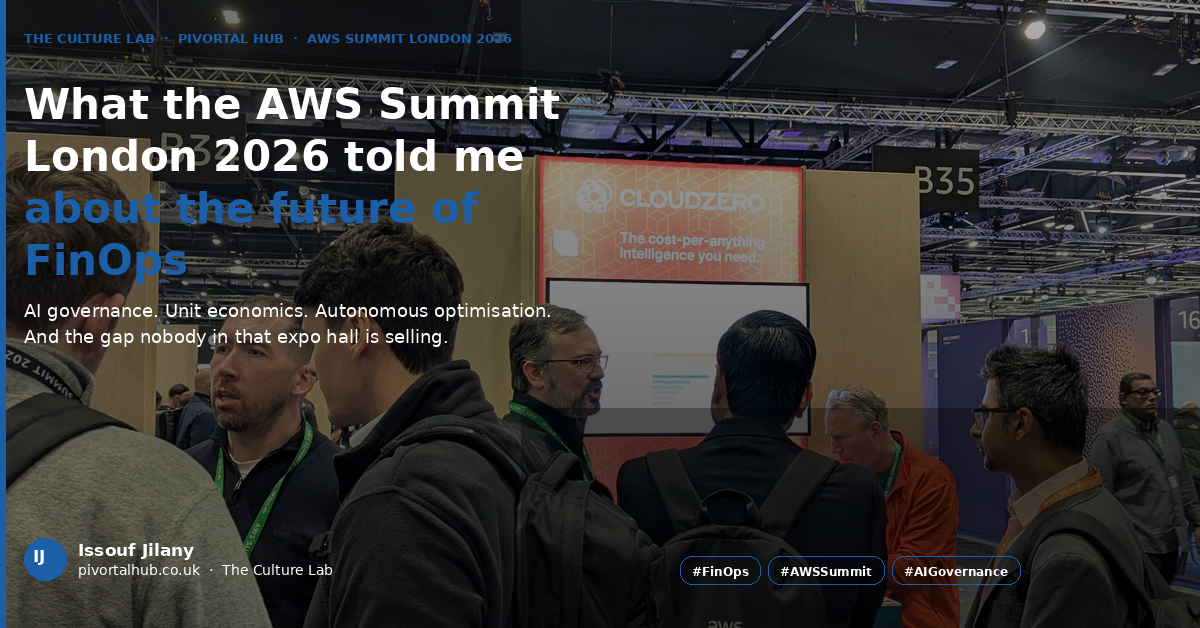
I was at AWS Summit London 2026 at ExCeL yesterday — 7,000+ attendees, 200+ sessions, the largest cloud technology gathering in the UK calendar. I spent most of my time not in the breakout rooms but on the expo floor, doing something I have never seen written about but which I believe is one of the most reliable ways to read where enterprise demand is actually heading.
Forget the keynotes. Forget the analyst briefings. Forget the carefully curated session abstracts.
Read the booths.
Every word on an expo stand has been through a product team, a marketing team and often a C-suite review. The companies paying tens of thousands of pounds for a floor presence at AWS Summit London have made a calculated commercial bet that the words above their stand will stop the right people in their tracks. Those words are not aspirational. They are market signals. They represent where the vendor believes enterprise money will flow over the next twelve to eighteen months.
Six words defined the AWS Summit London 2026 expo floor. Here is what each one told me about the state of enterprise technology — and what it means for delivery managers and FinOps practitioners.
Here is the paradox: organisations have never had more data. LogicMonitor's 2026 observability research found that 59% of organisations are drowning in telemetry but cannot get answers when they need them. They can see that something broke. They just cannot figure out what, why or how to fix it — let alone prevent it next time.
The vendors using "telemetry" on their booths are not selling data collection. They are selling signal extraction — the ability to pull the meaningful signal from exponentially growing noise.
96% of organisations are maintaining or increasing observability spending. 84% are pursuing unified platforms to reduce tool complexity. But the more important signal is this: Elastic's 2026 research confirms that governance, risk and compliance teams are now adopting observability data in 43% of organisations — extending its remit from "is the system running" to "is the system behaving within policy."
Observability has become the foundation of governance. And governance, in 2026, is the dominant enterprise concern.
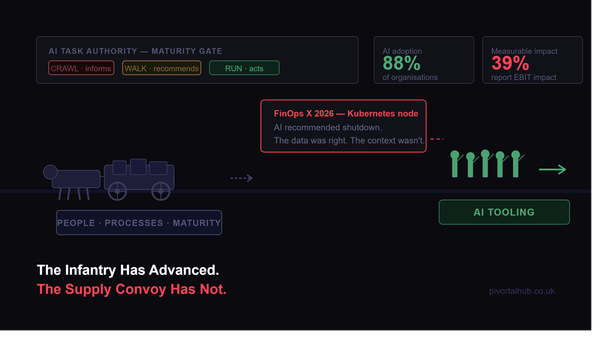
What makes "agentic" different from "AI" as a booth word is the implication of autonomy. Agentic AI systems do not wait to be asked. They reason, plan, act and adapt continuously — spinning up resources, calling APIs and accumulating costs without direct human instruction for each action.
Finout's positioning — "FinOps for the Agentic Era" — is the most forward-looking claim I saw at the Summit. They are explicitly building for the governance problem that most organisations have not yet encountered but will encounter within the next twelve months.
ProsperOps — managing $6 billion in cloud spend and having returned $4 billion in savings to customers — used "autonomous" deliberately. They execute Reserved Instance commitments. Not recommend them. Execute them. Flexible commitments that adapt as usage evolves, without human sign-off on each transaction.
But Gartner adds an important counterweight: more than 40% of agent projects will fail by 2027 due to runaway costs, unclear business value and agents that violate policy or create risk.
Elastic's 2026 observability survey found that 61% of organisations cite security as the primary concern when implementing generative AI. Gartner's analysis confirms that agents operating with autonomy create constant risk — bad data handling, policy violations and unintended actions are all documented failure modes.
The critical nuance: "trusted" is not a technical property. It is a governance property. You cannot make an AI system trusted by writing better code. You make it trusted by building accountability structures, audit trails, human-in-the-loop oversight and policy guardrails.
"Beyond Cloud" means: SaaS spend (90% of organisations). AI spend (98%). Software licensing (64%). Data centre (48%). The scope of technology value management has expanded beyond what any cloud-native FinOps tool was designed to handle.
The FinOps Foundation's 2026 mission update — from "value of cloud" to "value of technology" — is the policy statement for exactly this shift. FinOps+ by Kion's booth copy at AWS Summit London is the market's commercial response.
The meta-framework: why booth copy is the most honest market signal available
Let me make the framework explicit because I think it is genuinely useful for anyone trying to read where enterprise technology is heading.
Analyst reports are lagging indicators. They describe what organisations have already adopted. Vendor press releases are promotional. Conference session titles are curated.
Booth copy is different. It is written under commercial pressure to stop a specific person — the CTO, the cloud architect, the delivery manager with a budget problem — in their tracks within three seconds. Every word is tested against the question: will the right person stop walking when they see this?
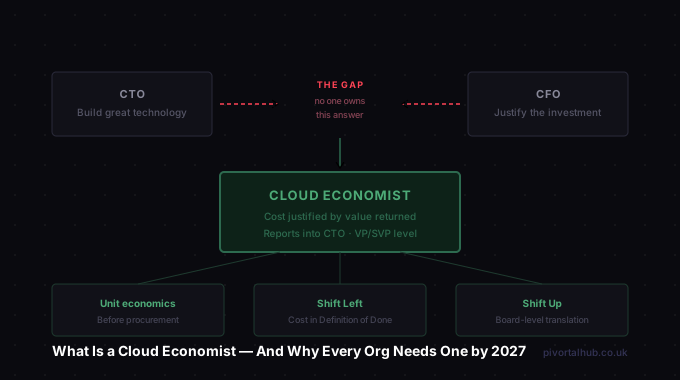
Someone has to embed cost attribution into the Definition of Done. Someone has to implement the Andon Cord so ungoverned AI usage is flagged at the point of architectural decision. Someone has to shift teams from feature delivery thinking to product ownership — from "we built what we were told" to "we own the outcome and its cost."
That someone is not a SaaS platform. That someone is a delivery manager who understands both the technology and the people — and has the coaching experience to change how teams think about value, not just how they process tickets.
The tools are getting better. The culture gap is getting wider. AWS Summit London 2026 confirmed both.
What word on an expo booth has caught your eye recently — and what do you think it signals about market demand? Drop it in the comments. The most interesting conversations on this platform happen when practitioners push back on the framework.
Further reading: What AWS Summit London 2026 told me about the future of FinOps · IBM Observability Trends 2026 · State of FinOps 2026