Jensen Huang Just Redefined Intelligence. It Sounds Exactly Like the Job Description of a FinOps Practitioner.
Jensen Huang defined intelligence as technical astuteness, empathy and inferring the unspoken. Here is why that is the exact job description of an evolved FinOps practitioner.
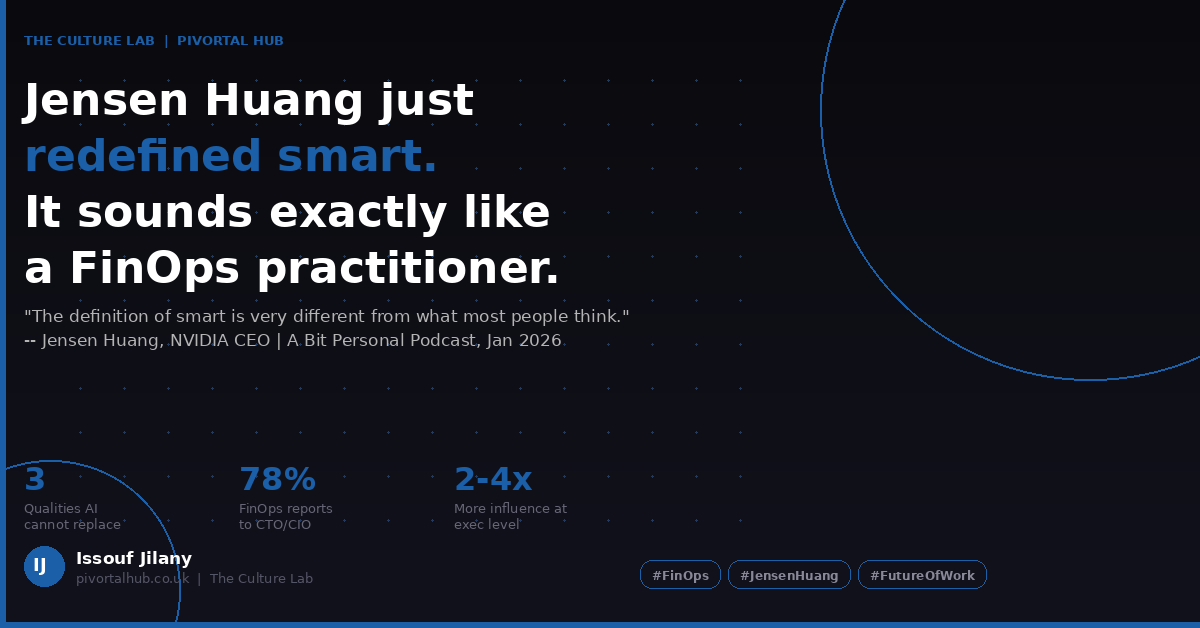
This article began with a podcast question and ended with a complete rethink of what it means to be valuable in the AI era. The source is Jensen Huang — NVIDIA CEO, the man whose GPUs are powering the largest transformation in the history of computing. The question was simple. The answer was not.
On 15 January 2026, Jodi Shelton asked Jensen Huang who the smartest person he had ever met.
Most people expected a name. A Silicon Valley rival. A Nobel Prize winner. A legendary engineer. Instead, Huang said: "I can't answer that question. And I know what people are thinking."
What followed was not a deflection. It was a redefinition.
"Everybody thought software programming was the ultimate smart profession. Look what is the first thing that AI is solving? So it turns out that the definition of smart is very different from what most people think."
— Jensen Huang, NVIDIA CEO | A Bit Personal with Jodi Shelton, 15 January 2026For Huang, the long-term definition of intelligence in the AI era is someone who sits at the intersection of three qualities:
I read those three qualities together and thought: who in your organisation does that job?
The answer — if you have one — is almost certainly not your best cloud cost analyst. And it is almost certainly not your most technically skilled engineer.
It is the delivery manager or FinOps practitioner who has stopped asking "what did we spend" and started asking "what should we invest in and why."
What Huang actually said — and what most commentators missed
The reaction to Huang's answer was largely philosophical. Commentators wrote about emotional intelligence, the limitations of IQ, empathy as a leadership skill. All valid. But almost everyone missed the specific, structural argument he was making.
Huang was not saying technical skills do not matter. He was saying technical skills, in isolation, are becoming a commodity.
He was explicit: "Everybody thought software programming was the ultimate smart profession. Look what is the first thing that AI is solving?"
This is not a casual observation from a philosopher. This is a statement from the man whose company's GPUs are powering the largest transformation in the history of computing. When Jensen Huang says technical problem-solving is being automated, he is speaking from complete technical authority — and he is saying that the traditional marker of intelligence, the thing we pointed at and said "that person is smart," is no longer a meaningful differentiator.
The differentiator, in his framing, is the combination that remains after technical skill is commoditised: technical astuteness plus empathy plus the ability to infer what nobody has yet said.
Why this destroys the old model of FinOps
The traditional FinOps practitioner was built for a specific job. Read the billing dashboard. Identify the rightsizing opportunity. Recommend the Reserved Instance purchase. Flag the anomaly. Produce the monthly cost report.
That job description is Huang's definition of what AI is solving first.
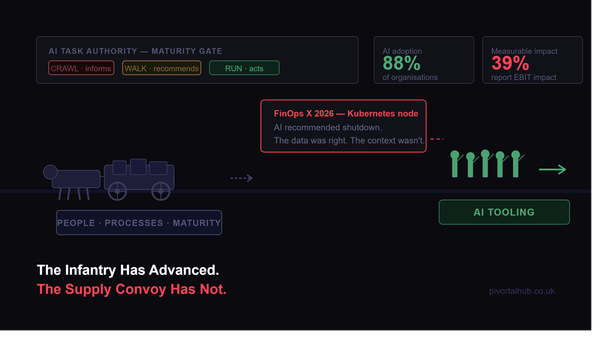
Cost analysis is a technical task. Anomaly detection is a technical task. Commitment recommendation is a technical task. These are exactly the capabilities that vendors like CloudZero, ProsperOps and Finout — who I saw at AWS Summit London this week — are building automated platforms to perform. ProsperOps is already executing autonomous commitment decisions without human approval on each transaction. CloudZero is building cost-per-anything intelligence that surfaces unit economics without a human analyst running the calculation.
Huang's framing makes this structural shift legible: the task is being automated. The role is being elevated.
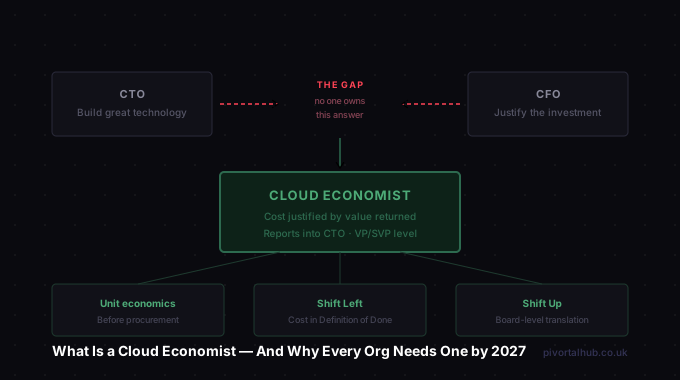
The FinOps practitioner who defines their value by technical mastery of billing tools is the software programmer in Huang's example. The FinOps practitioner who defines their value by the ability to translate cost data into executive strategy — empathetically, with an understanding of what the CFO and the CTO each need to hear, inferring the unspoken tension between financial control and technology investment — is the person Huang is describing as the future definition of intelligent.
The brewery — and what it has to do with all of this
Looking back across twenty years of delivery leadership, the moments that made the most difference were never the ones where I was the most technically capable person in the room.
At the Alcohol Duty Reform programme at HMRC, the most valuable thing I did was not run the sprint ceremonies or manage the backlog. It was taking the delivery team to visit breweries and spirit makers — a genuine Gemba Walk — to understand the real-world complexity that no requirements document had captured. Technical astuteness to understand what we were building. Empathy to understand what the brewers actually needed. The ability to infer what nobody had said explicitly — that the legislative requirements as written were based on a misunderstanding of how small craft breweries actually operated.
That insight reshaped the entire programme backlog. No dashboard would have surfaced it. No AI model trained on policy documents would have found it. It required a human being to be in the room — in the brewery — and synthesise what they were seeing, hearing and feeling into a course of action.
That is Huang's definition of smart. Applied to delivery management. Applied to the FinOps practitioner who has stopped asking "what did we spend" and started asking "what should we invest in and why."
The three shifts Huang's definition demands of FinOps practitioners
The line that should be on every FinOps practitioner's wall
You will not lose your FinOps role to a CloudZero dashboard or a ProsperOps autonomous optimisation engine. You will lose it to the FinOps practitioner who uses those tools as infrastructure — freeing their time from the analytical tasks being automated — and invests that freed time in developing the capabilities Huang describes.
Technical astuteness. Empathy. The ability to infer the unspoken.
The practitioner who treats FinOps tools as a replacement for their thinking will be replaced. The practitioner who treats FinOps tools as an amplifier for their thinking will be indispensable.
What I am taking from this personally
I have been building PivortalHub — The Culture Lab — as a platform for practitioners who believe FinOps is 20% mathematics and 80% culture. Huang's redefinition of intelligence confirms that framing in a way I did not expect when I started writing these articles.
The mathematics of FinOps — billing data, unit economics, commitment models, tagging governance — is the technical astuteness layer. It is necessary. It is not sufficient.
The culture of FinOps — Communities of Practice, Definition of Done, stakeholder coaching, Scrum of Scrums, the shift from feature delivery to product ownership — is the empathy and inference layer. It is the part that cannot be automated, cannot be outsourced to a dashboard and cannot be taught by a certification exam.
Jensen Huang, from the stage of a personal podcast on 15 January 2026, described the practitioner I am trying to be and the practitioner I am trying to help others become.
Technically astute. Empathetic. Able to infer the unspoken.
That is not a new definition of smart. That is a very old definition — the one that has always separated the practitioners who make change happen from the ones who describe it. AI has just made it the only definition that matters.
What is your reaction to Huang's definition? Do you think it describes the FinOps practitioner, the delivery manager — or both? Drop it in the comments. The most interesting conversations on this platform happen when practitioners push back on the framework.
Further reading and watching: Jensen Huang — A Bit Personal with Jodi Shelton, Episode 1 (YouTube) · Read the Booth. Read the Market. AWS Summit London 2026 · State of FinOps 2026 report