What AWS Summit London 2026 Told Me About the Future of FinOps
I spent the day at AWS Summit London 2026. Here is what the expo floor told me about AI governance, unit economics and the gap nobody is selling.
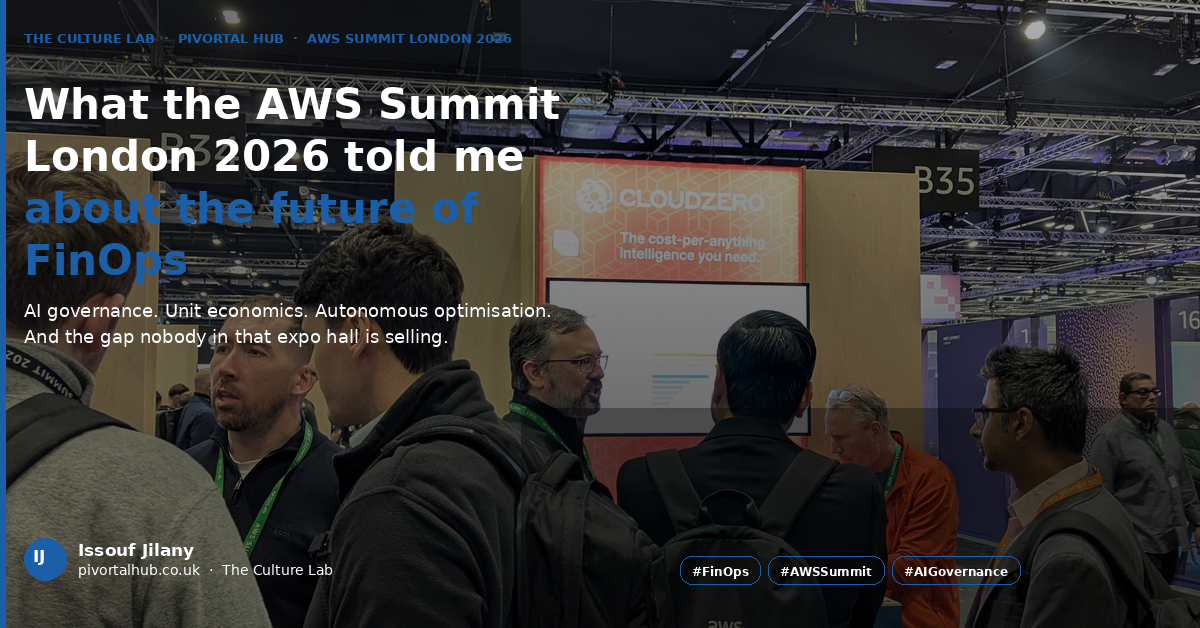
I was at AWS Summit London 2026 today — 7,000+ attendees, 200+ sessions, ExCeL London. I spent most of the day on the expo floor rather than in the breakout rooms. Here is what I saw and what it means for delivery managers and FinOps practitioners in the UK market.
There are two ways to experience a technology summit. You can spend the day in sessions absorbing carefully crafted vendor narratives. Or you can walk the expo floor and watch what practitioners are actually stopping to look at, asking about and photographing.
I did the second. And what I saw confirmed something I have been writing about on The Culture Lab for the past several months — the market has caught up with what FinOps practitioners have been saying for two years. AI governance is no longer a practitioner conversation. It is a product category. And the implications for delivery managers are significant.
Here are the five things the AWS Summit London 2026 expo floor told me about where FinOps is heading.
1. AI governance is now a product category — not just a practice
Walk the expo floor at any major cloud event and you can read the market's current obsession from the booth signage. Two years ago every sign said "cloud cost optimisation." Last year it shifted to "multi-cloud visibility." This year, the dominant phrase was AI governance.
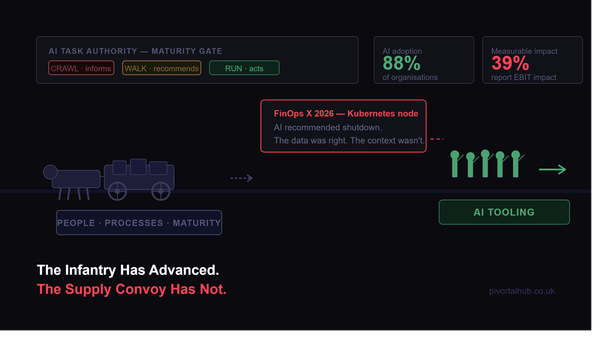
The State of FinOps 2026 report confirmed that 98% of organisations now manage AI spend — up from 31% just two years ago. The vendors at AWS Summit London have read that report and built their 2026 positioning around it.
The question is no longer whether AI spend needs to be governed. The question is who inside your organisation owns that governance — and whether they have the delivery infrastructure to make it stick.
2. Unit economics is going mainstream
The booth that stopped me longest was CloudZero. Their tagline — "the cost-per-anything intelligence you need" — is the most important phrase I saw at the Summit today.
Cost-per-anything. Not cost-per-cloud-resource. Not cost-per-service. Anything.
This is the operationalisation of unit economics at scale. Cost per customer. Cost per transaction. Cost per token. Cost per inference. Cost per product feature. The move from "what did we spend on AWS this month" to "what did each unit of business value actually cost us to produce."
In my article on Shift Up — the FinOps Foundation's new Executive Strategy Alignment capability — I wrote about the importance of presenting AI investment in unit economic terms to board-level stakeholders. Cost per token and cost per inference alongside cost per transaction and cost to serve. CloudZero's positioning at the Summit confirms that this is not just a FinOps practitioner ideal. It is becoming a commercial product category.
The implication for delivery managers: the teams you lead will increasingly be measured not on features shipped or velocity achieved, but on the unit economics of what they build. The Definition of Done will need to include cost attribution — not as a compliance checkbox, but as a genuine quality criterion.
3. Autonomous optimisation changes the FinOps practitioner's role
ProsperOps — a Flexera company — had one of the most striking booths at the Summit. Their numbers were visible from across the expo hall:
That last point matters. ProsperOps does not recommend Reserved Instance purchases and wait for a human to approve them. It executes autonomously — flexible commitments that adapt as usage and infrastructure evolve.
When AI governs the commitments, what does the human FinOps practitioner do?
This is the question I kept returning to as I walked the expo floor. The tooling is maturing faster than most practitioners realise. The optimisation work — rightsizing, commitment management, waste identification — is being automated. The billing data is being normalised through the FOCUS specification. The dashboards are getting better.
When the machines handle the optimisation, the humans handle the governance, the culture and the accountability. That is not a threat to the FinOps practitioner's role. It is an elevation of it. The same shift that happened to DevOps when CI/CD pipelines automated the build and deploy cycle — the humans moved up the value stack.
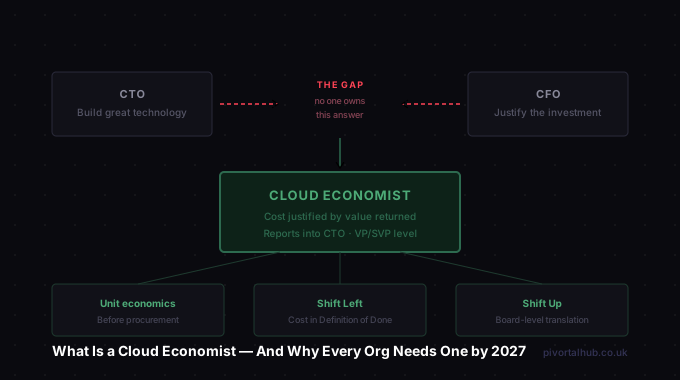
This is precisely what the FinOps Foundation means by Shift Up. And it is precisely why delivery managers — who already operate at the intersection of engineering culture and executive strategy — are the natural owners of this elevated role.
4. Observability and FinOps are converging
Walk the sponsor list at AWS Summit London and count the observability vendors. Datadog (Global Sponsor). Dynatrace (Platinum). Tsuga (expo floor). Splunk/Cisco (Platinum).
Every observability vendor is adding cost intelligence. Every FinOps vendor is adding performance data. The two disciplines — which have historically operated in completely separate tools, teams and conversations — are converging into a single unified view of technology value.
Tsuga's positioning — "Observability. Run in your cloud. Managed by us" — is a glimpse of where this goes. Enterprise observability that runs in your own cloud infrastructure, managed externally, feeding data into both performance and cost decision-making simultaneously.
The implication is structural. The separation between "the team that watches the performance dashboards" and "the team that watches the cost dashboards" is artificial and increasingly expensive. Organisations that integrate these two views — that treat cost as a dimension of performance rather than a separate reporting function — will make faster and better technology investment decisions.
This is the unified ledger that the State of FinOps 2026 described as the market's most-wanted capability. The vendors at AWS Summit London are building it.
5. The gap nobody in that expo hall is selling
Here is the most important observation from my day at AWS Summit London.
Every vendor I visited is building tools. Sophisticated, well-funded, genuinely impressive tools. CloudZero for unit economics. ProsperOps for autonomous optimisation. Finout for agentic AI cost management. FinOps+ by Kion for multi-technology governance. HAProxy for self-service infrastructure control.
Not one of them is selling the thing that makes those tools work.
Someone has to implement the Andon Cord — the lean manufacturing principle of stopping the line when a problem is spotted — so that ungoverned AI service usage is flagged at the point of the architectural decision rather than six weeks later when the invoice arrives.
Someone has to shift the team from feature delivery thinking to product ownership — from "we built what we were told" to "we own the outcome and its cost."
That someone is not a SaaS platform. That someone is a delivery manager who understands both the technology and the people — and has the coaching experience to change how teams think about value, not just how they process tickets.
I have been writing about this gap on The Culture Lab since I launched PivortalHub. My thesis — that FinOps is 20% mathematics and 80% culture — is not contradicted by the tools I saw at AWS Summit London today. It is confirmed by them.
The tools are getting better. The culture gap is getting wider. Every new capability that the platforms automate is one more reason for organisations to assume the human work is done. It is not. It is just beginning.
What I took from Werner Vogels
The closing keynote from Werner Vogels, CTO of Amazon, brought together the themes I had been absorbing from the expo floor all day.
The message that stayed with me: the organisations that will win in the agentic AI era are not the ones with the biggest models or the most cloud spend. They are the ones that have built the governance infrastructure to deploy AI responsibly, measure its value precisely and adjust course quickly when it is not delivering.
That is a delivery problem. It is an Agile problem. It is a FinOps problem. And it is a culture problem.
The vendors at AWS Summit London are solving the tooling layer. The delivery managers and FinOps practitioners in the room — the ones with green badges and practitioner lanyards — are the ones who have to solve everything beneath it.
What this means for your organisation — three actions this week
Were you at AWS Summit London today? I would genuinely like to hear what you took from it — which vendors you spoke to, which sessions surprised you and what you are taking back to your organisation. Drop it in the comments.
Further reading: How to embed cloud cost into your Definition of Done · Shift Up: FinOps just became a boardroom discipline · State of FinOps 2026 report