Why Your AWS Billing Alerts Are Basically Useless
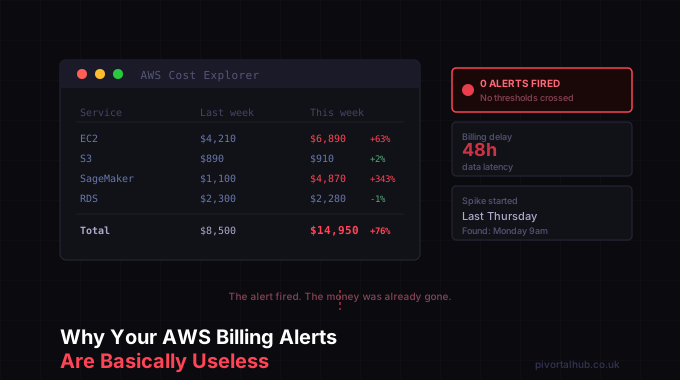
AWS billing alerts have a 24–48 hour data delay. By the time they fire, the money is already gone. Here's why the threshold model is broken — and what the fix actually looks like.
FinOps Insight · The Culture Lab
Why Your AWS Billing Alerts Are Basically Useless
The threshold model was working exactly as designed. The design was the problem.
Issouf Jilany · June 2026 · 7 min read
"The alert fired. The money was already gone."
There is a specific kind of silence that FinOps practitioners know well. It is the silence of a Monday morning, a cup of coffee, and a Cost Explorer screen showing a number that is 40% higher than it should be. Nobody flagged it. No alert fired. The spend happened sometime last Thursday. Today is too late to do anything except explain it.
I have sat in that silence more times than I want to count. And every time, the post-mortem reveals the same thing: AWS sent no alert because nothing technically crossed a threshold. The threshold model was working exactly as designed. The design was the problem.
Your alerts are built on an assumption that does not hold
AWS CloudWatch Billing Alerts operate on a simple threshold model. You set a number. When estimated charges cross it, you get notified. It sounds reasonable. In practice it breaks in three ways that compound each other.
First, the data is stale by the time you see it. AWS Cost Anomaly Detection uses data from Cost Explorer, which has a delay of up to 24 hours — meaning it can take up to 24 hours to detect an anomaly after usage occurs. Cost Explorer typically has 24 to 48 hour latency, and the Cost and Usage Report can take even longer to deliver the granular data required for deep analysis. You are not monitoring your cloud spend. You are reading last night's newspaper and calling it news.
Second, the threshold model assumes your spend is predictable. It is not. Cloud spend is nonlinear. A single misconfigured auto-scaling group, a forgotten GPU instance, a data pipeline that scans 10TB instead of 10GB — these do not approach a threshold gradually. They spike. By the time the spike crosses your alert boundary, it has already been running for hours.
Third — and this is the one nobody talks about — all of the major AWS billing tools use the same underlying billing pipeline and have comparable latency. CloudWatch Alarms, AWS Budgets, and Cost Anomaly Detection cannot reliably detect spend faster than approximately six hours at best. This is a fundamental AWS constraint. You can stack tools on top of each other and the underlying delay does not move.
The threshold model punishes the responsible and ignores the reckless
Here is what a well-configured billing alert actually does. It tells you that you have already crossed a budget boundary. Not that you are approaching it. Not that something unusual is happening. That the damage is done.
I have seen engineering teams respond to this in two ways. Some become alert-fatigued — they set thresholds high enough that the alerts rarely fire, which means the alerts are useless. Others set thresholds low and get flooded with notifications during legitimate traffic spikes, which means the alerts become noise and get ignored. Neither response is wrong. Both are rational adaptations to a broken tool.
Adobe once generated a surprise cloud bill of over $500k because they left a computing job running on Azure. One alert acting on real-time usage data would have been enough to prevent it. Adobe is not an unsophisticated organisation. They had monitoring in place. The monitoring was threshold-based. The job ran continuously, never breaching a threshold in a single billing period. It accumulated quietly for weeks. This is not a failure of alerting diligence. It is a failure of alerting architecture.
What AWS Cost Anomaly Detection actually gives you — and what it doesn't
To be fair to AWS, Cost Anomaly Detection is a meaningful step forward over static CloudWatch thresholds. It uses machine learning models rather than fixed numbers, which means it learns your spend patterns and flags deviations from expected behaviour. After your billing data is processed, it runs approximately three times a day to scan for anomalies.
That is better than a manually set threshold. It is not the same as real-time. The detection still depends on the same billing pipeline. You can tune the sensitivity, get alerts via SNS or Slack, build monitors by account, service, or cost category. None of that changes the 24 to 48 hour window between when spend occurs and when the anomaly is flagged.
What it does well: it catches sustained deviations that a static threshold would miss. A workload creeping 15% higher per day for a week will not cross a single-threshold alert until day five or six. Anomaly Detection catches the pattern earlier. What it cannot do: tell you about a spike that happened two hours ago, give you actionable data before the cost has already landed, or integrate with the moment a developer deploys a change rather than the moment the billing system catches up.
The fix is not a better alert. It is a different model entirely.
The problem with billing alerts is not that they are poorly configured. It is that they are downstream. They operate at the billing layer, after cost has been incurred, after the data has been aggregated, after the pipeline has processed it. By design, they are reactive.
The Shift Left principle — which the FinOps Foundation formally recognised in their 2026 Framework update — addresses this at the source. Cost needs to be visible at the point of engineering decision, not the point of billing review. That means tagging governance enforced before deployment, not audited after. Cost estimates built into pull request pipelines, not discovered in Cost Explorer. Rightsizing recommendations surfaced during sprint planning, not in the monthly FinOps meeting.
When cost is embedded into the engineering workflow — into the Definition of Done, into the deployment checklist, into the architect's decision criteria — the billing alert becomes the last line of defence rather than the first. Right now, for most teams, it is the only line of defence. And it has a 24 to 48 hour delay. That is not a monitoring problem. It is a governance model problem.
What I am doing right now
- Running tagging policy checks as part of CI/CD pipelines — code that deploys untagged resources fails the build before it touches production
- Embedding estimated cost impact into the Definition of Done for any infrastructure change
- Using AWS resource-level tagging to tie spend to sprint deliverables, not just service categories
- Building a team habit of reviewing cost attribution in sprint review alongside velocity and quality metrics
- Flagging any resource created without a defined decommission date as a governance breach, not a billing afterthought
The billing alert still exists. But it fires rarely — because the governance upstream catches the problem before it becomes a cost.
Here is what I want to know from practitioners reading this. Not what tools you are using — that is the wrong question. The right question is: how long does it take your team to find out that something is costing significantly more than expected — and who finds it first?
If the answer is days, and the answer is finance, then the alert is not the problem. The governance model is. What does your current alerting setup actually catch — and what does it miss?
About the Author
Issouf Jilany is a FinOps & Cloud Cost Optimisation Consultant, AWS Solutions Architect, and IBM Apptio Cloudability practitioner with approximately 20 years of delivery leadership experience across financial services and the public sector — including Lehman Brothers, Reuters, Lloyd's of London, HMRC and OFGEM. He is the founder of PivortalHub — a thought leadership platform at the intersection of FinOps, AI delivery, and cloud economics. SAFe SPC · SAFe RTE · AWS Solutions Architect Associate · IBM Apptio Cloudability.
Published on pivortalhub.co.uk · The Culture Lab