The $100 Billion Cloud Waste Problem Nobody Is Watching in Real Time
Cloud organisations waste over $100 billion annually. The enterprise tools claim to catch it — at enterprise prices and enterprise complexity. Here is what the market is missing, who is being left exposed, and what real-time monitoring actually means.

FinOps · Cloud Cost Governance · The Culture Lab
The tools that claim to catch it are either too expensive, too slow, or too complex to deploy. Here is what is actually happening — and who is being left exposed.
Issouf Jilany · October 2026 · 9 min read
Cloud organisations waste roughly 27% of their cloud spend. With global public cloud spending hitting approximately $1.03 trillion in 2026, that is over $100 billion sitting in running infrastructure that is delivering no value — forgotten instances, orphaned environments, misconfigured auto-scaling groups, test workloads that outlived their sprint. Every pound of it accumulates in silence, billed to your account in the background while your team ships the next feature.
The market has no shortage of tools claiming to solve this. IBM Apptio Cloudability. CloudZero. Vantage. Finout. Datadog Cloud Cost Management. And now AWS's own FinOps Agent, launched at FinOps X in June 2026. Each of them promises anomaly detection. Each of them promises alerts. Each of them promises that the next surprise cloud bill will not catch you off guard.
I have been looking closely at this market for the last six months — from inside live delivery programmes, from the AWS console, and now from building a detection layer myself. Here is what I have found: the tools that claim to watch your cloud spend in real time mostly do not. And the organisations that need it most are the ones the market has entirely failed to build for.
"The enterprise tools have anomaly detection. They also have enterprise pricing, enterprise complexity, and a sales cycle. The organisation that needs fast detection most cannot afford to wait for either."
The enterprise tools claim to solve this — at enterprise prices
CloudZero hit $42 million in ARR in March 2026, growing fast, and its anomaly detection is genuinely strong — AI-powered, using hourly spend data compared against 12 months of historical patterns. Vantage offers automated anomaly detection that alerts teams to spending spikes within minutes and supports 20+ SaaS integrations including OpenAI and Anthropic token costs. Finout's seasonality-aware detection cut anomaly investigation time at Lyft from weeks to days.
These are real capabilities. I am not dismissing them. But they share three characteristics that matter enormously when you are assessing who they actually serve.
First, pricing is opaque and scales with your cloud spend under management. CloudZero does not publish a rate card. Neither does Cloudability. Vantage is more transparent but still requires a conversation. For an organisation spending £50,000 a month on cloud, the cost of enterprise FinOps tooling often cannot be justified against the waste it catches — especially when that organisation does not yet have the tagging infrastructure the tools need to function properly.
Second, these tools require engineering lift to deploy correctly. CloudZero's unit economics model requires tagging at the resource level, cost allocation by product line, and engineering involvement in setup. That is weeks of work before a single alert fires. For a solo FinOps practitioner at a 300-person company, that timeline is not theoretical — it is the reason the tool sits in a proof-of-concept state for six months and never reaches production.
Third — and this is the one that the market glosses over — every one of these tools ultimately depends on the same underlying billing pipeline. The billing data has latency. The anomaly detection model runs on that data. The alert fires after the data arrives. Claiming "real-time" detection while sitting on top of a billing pipeline with hours of latency is a marketing position, not a technical one.
I tested AWS's own answer this week — and confirmed what I suspected
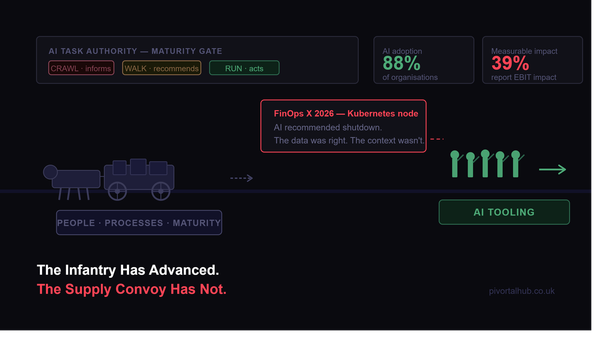
AWS launched the FinOps Agent into public preview on June 9, 2026, at FinOps X — the same conference where Ishita Vyas of the FinOps Foundation demonstrated the Kubernetes node failure that I wrote about in The Infantry Has Advanced. The AWS FinOps Agent is built on Bedrock, connects to Cost Explorer, Cost Anomaly Detection, Cost Optimization Hub, and Compute Optimizer, and routes findings to Slack and Jira. It is genuinely impressive as a conversational interface over AWS cost data.
This week I set it up on my own AWS account — the account that hosts PivortalHub — and ran it through its paces. I asked it to investigate cost anomalies in the last seven days. It told me none had been detected. I asked it to correlate any cost changes with CloudTrail to identify the API calls and IAM principals behind them. It told me it could not do that — CloudTrail access is outside its read-only cost toolset.
Then I asked it to set up an automation to fire whenever AWS Cost Anomaly Detection identifies an anomaly over $5 and post the summary to Slack. Its response was instructive: it could create the automation, but the trigger — the thing that starts the whole chain — is AWS Cost Anomaly Detection. Which means the alert inherits Cost Anomaly Detection's detection latency. The same 24-48 hour billing pipeline gap I wrote about in the first piece in this series. The conversational wrapper is new. The underlying detection lag is unchanged.
The AWS FinOps Agent is an analyst you have to talk to. It answers your cost questions well. What it cannot do is watch your account continuously, without being asked, and tell you about a spend spike two hours after it starts — before the bill has accumulated to the point where it is visible in the billing pipeline.
The customer nobody is building for is the one most exposed
The FinOps tools market has a clear target customer: the enterprise with a dedicated FinOps team, mature tagging infrastructure, and a cloud bill large enough to justify five-figure annual tooling contracts. CloudZero's $42M ARR is built on that customer. Vantage and Finout are competing for a share of the same market.
There is a large and almost entirely unserved segment sitting below that market. It is the solo FinOps practitioner or small engineering team at a company spending £50,000–£500,000 a month on cloud. This organisation is too big to ignore the cloud bill. It is too small — or too early in its FinOps maturity — to justify enterprise tooling. It has AWS Cost Anomaly Detection turned on and assumes that covers it.
The FinOps Foundation's State of FinOps 2026 found that 98% of organisations now manage AI spend — up from 31% two years ago. That means the spend base has expanded dramatically, but the maturity of the teams governing it has not kept pace. The organisation that newly has a $50,000 monthly AI inference bill does not have a CloudZero contract alongside it. It has an AWS billing alert set at a threshold that made sense for its 2023 spend profile, and a solo FinOps practitioner checking Cost Explorer on Monday mornings.
This is the organisation that discovered the problem I described in the first article in this series. The alert fired. The money was already gone. The spend had been accumulating since Thursday. The billing pipeline showed it on Monday morning. Nobody was watching on Friday afternoon.
Real-time monitoring is not what most FinOps tools actually deliver
Let me be precise about what I mean by real-time, because the term is used loosely in this market. CloudZero uses hourly data. Vantage claims alerts within minutes. Both of these are better than the 24-48 hour native AWS billing pipeline. Neither of them is monitoring your cloud spend at the moment it occurs.
True real-time cloud cost monitoring does not yet exist as a product — and the reason is architectural. Cloud billing data is aggregated, processed, and delivered with inherent latency. AWS Cost Explorer has 24-48 hour latency at the billing layer. Hourly granularity — which AWS now offers as a paid feature — reduces this but does not eliminate it. The question is not whether you can achieve zero latency. You cannot. The question is whether you can close the gap from 24-48 hours to 2-6 hours — and whether you can do it at a cost and complexity level that the mid-market practitioner can actually deploy and sustain.
The Shift Left principle that the FinOps Foundation formally recognised in their 2026 Framework update points at the deeper solution: cost governance that operates upstream of the billing pipeline, not downstream. Embedding cost checks into CI/CD pipelines, requiring cost impact estimates in pull requests, flagging untagged resources at deployment rather than at billing review — these are the mechanisms that catch the problem before it becomes a cost. They do not replace anomaly detection. They reduce the frequency with which anomaly detection has to fire.
The combination that actually works is not one tool. It is a detection layer that operates as close to real-time as the billing pipeline allows, running continuously without requiring human initiation, integrated with the channels where engineers already live — and upstream governance that reduces the frequency and severity of the anomalies that layer has to catch.
What I am doing right now
- Deployed a Lambda-based anomaly detector on the PivortalHub AWS account — running every 30 minutes, comparing current spend against a 14-day rolling baseline, firing alerts to both email and Slack when deviation exceeds 50% above baseline
- Tested the AWS FinOps Agent in public preview this week — confirmed it is reactive and conversational, not a continuous watchdog; its anomaly detection inherits the same 24-48 hour billing pipeline lag as native AWS Cost Anomaly Detection
- Mapping the detection gap across the FinOps tooling landscape — CloudZero and Vantage close it partially at enterprise pricing; no tool currently closes it at mid-market pricing with minimal deployment complexity
- Embedding cost tagging policy checks into CI/CD pipelines at client level — resources that deploy without required tags fail the build before they reach production, reducing the surface area for anomaly detection to cover
- Using IBM Apptio Cloudability for cross-cloud spend allocation and chargeback reporting — the enterprise reporting layer sits on top of the detection layer, not in place of it
The watchdog is missing for most organisations
The $100 billion cloud waste figure is arresting because of its scale. But the more important number is the one specific to your organisation. If you are spending £100,000 a month on cloud and wasting 27% of it, that is £27,000 a month accumulating in infrastructure that is delivering no value. A detection system that catches a spike six hours after it starts rather than 48 hours saves you a meaningful fraction of that number every time it fires.
The enterprise market has tools for this. They are expensive, complex, and built for organisations with mature FinOps practices. The mid-market — the solo practitioner, the small engineering team, the organisation newly managing AI spend without a FinOps function to govern it — is running on native AWS alerting and hoping the billing pipeline is faster than it is.
The AWS FinOps Agent is impressive. CloudZero is impressive. Vantage is impressive. None of them are the watchdog for the organisation that cannot afford a watchdog. That gap is real, it is large, and it is the most interesting unsolved problem in the FinOps tools market right now. How long does it take your team to find out that something is costing significantly more than expected — and is that fast enough to matter?
About the Author
Issouf Jilany is a FinOps & Cloud Cost Optimisation Consultant, AWS Solutions Architect, and IBM Apptio Cloudability practitioner currently engaged at Lean Icon Technology. He is the founder of PivortalHub — a thought leadership platform at the intersection of FinOps, AI delivery, and cloud economics. MSc Financial Economics · MBA · SAFe SPC · SAFe RTE · AWS Solutions Architect Associate · IBM Apptio Cloudability.
Sources referenced in this article
FinOps Foundation (2026). State of FinOps 2026. Sixth annual survey. data.finops.org
AWS (2026). AWS FinOps Agent — Public Preview. Launched FinOps X 2026, June 9. aws.amazon.com
Sacra (2026). CloudZero — Company Profile. ARR and market analysis. sacra.com
Vyas, I. (2026). Agentic FinOps Maturity: Crawl, Walk, Run. FinOps X 2026 Day 2 Keynote. FinOps Foundation. finops.org
Amnic (2026). 10 Best Cloud Cost Anomaly Detection Tools 2026. Detection latency and market comparison. amnic.com
Finout (2026). Finout vs CloudZero: A Side-by-Side Breakdown for 2026. finout.io
Jilany, I. (2026). Why Your AWS Billing Alerts Are Basically Useless. PivortalHub — The Culture Lab. pivortalhub.co.uk
Published on pivortalhub.co.uk · The Culture Lab