The New User of Your SaaS Platform Is Not Human. It Is Headless.
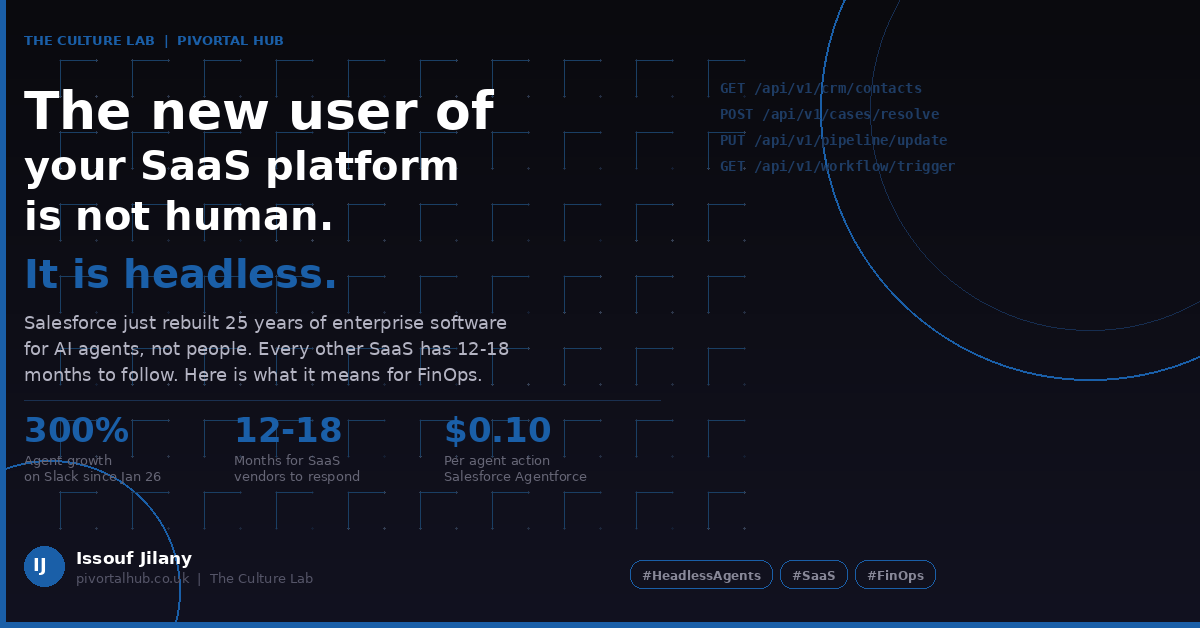
Salesforce just rebuilt itself for AI agents. Every other SaaS company has 12-18 months to follow. Here is what headless agents mean for FinOps and delivery governance.
Salesforce Co-Founder Parker Harris asked a question at TDX 2026 that should stop every CTO, programme director and FinOps practitioner in their tracks. "Why should you ever log into Salesforce again?" Not as a provocation. As direction.
For twenty-five years, enterprise software was built on a single assumption: the person using the platform was a human being sitting at a screen. Dashboards were designed for human eyes. Navigation was designed for human hands. Every UX decision in the history of enterprise software was made with one user in mind.
That assumption has just been broken. Publicly, deliberately and at scale.
On 15 April 2026, Salesforce announced Headless 360 at its TrailblazerDX developer conference — declaring that "everything on Salesforce is now an API, MCP tool, or CLI command, and agents can use all of it." Constellation Research analyst Holger Mueller called it a move that puts Salesforce "squarely one to two years ahead of its peers in building agents."
The implications go far beyond Salesforce. Every other SaaS vendor has roughly 12 to 18 months to respond. Headless is becoming the new default for enterprise software. And every FinOps practitioner and delivery manager has far less time than that to understand what it means for how they govern technology spend.
What Jordan Wilson saw coming
Before the Salesforce announcement gave the concept a name the enterprise market could rally around, Jordan Wilson of Everyday AI had been talking about headless agents for months. His observation was deceptively simple.
Every SaaS platform that exists today was built for human interaction. Humans need visual interfaces — dashboards, screens, buttons, menus. The entire UX design industry exists to serve that need.
But the new consumer of SaaS platforms is not a human. It is an agent. And agents do not need a dashboard. They need an API.
This is not a marginal observation. It is a structural shift in who software is built for. Salesforce — the company that built its entire empire on the visual CRM, the pipeline dashboard, the drag-and-drop interface — has just validated it in the most public way possible.
What Headless 360 actually is
Salesforce Headless 360 is an API-first, agent-ready version of the Salesforce platform that exposes CRM, Data Cloud and workflow capabilities as APIs, Model Context Protocol (MCP) tools and CLI commands. It lets AI agents and developer tools operate Salesforce without using the Lightning UI.
Two and a half years ago, Salesforce made a decision: rebuild Salesforce for agents. The result ships with 60+ new MCP tools and 30+ preconfigured coding skills giving coding agents complete, live access to the entire platform — directly in the tools they already use, including Claude Code, Cursor and Codex — without touching a browser.
But the most significant signal in the announcement is not the architecture. It is the pricing.
That is not just a pricing change. It is the most explicit possible signal that Salesforce believes the volume of agent interactions will far exceed the volume of human interactions on its platform within the near term.
The financial implications for organisations that currently budget for SaaS on a per-seat basis are enormous. And almost nobody is governing them.
Current Salesforce Agentforce pricing and consumption model: salesforce.com/agentforce/pricing — Flex Credits: $500 per 100,000 credits · $0.10 per standard agent action · $2 per conversation (alternative model) · Free tier: 200,000 Flex Credits via Salesforce Foundations. Pricing subject to change — verify with your Salesforce account executive.
The SaaStr reality check
The most striking commentary on the Headless 360 announcement came not from an analyst but from Jason Lemkin at SaaStr, who confirmed it from live production:
"Three humans, one dog, 20+ AI agents in production. Salesforce is the system of record for every deal, every contact, every sponsorship, every event registration, every support ticket. And almost nobody logs into it. The agents do. Humans barely do."
— Jason Lemkin, SaaStr | April 2026That is not a forward-looking scenario. That is a live production environment, operating today, at a company that has already crossed the threshold that most organisations are still debating.
The agentic future is not coming. It is already here, operating in production at companies that chose to embrace it 6 to 12 months ago.
Why this is a FinOps emergency — not just an architecture conversation
For the past decade, FinOps has been built around a relatively stable model of how cloud and SaaS costs are generated. A human logs in, uses a feature, generates a cost, and the FinOps team analyses the bill. That model has three assumptions embedded in it that the headless agent era destroys simultaneously.
This is why every observability and FinOps vendor on the AWS Summit London 2026 expo floor was using the word telemetry. You cannot see a headless agent in a dashboard. You can only see it in raw API telemetry — logs, traces, metrics. The signals nobody was watching because nobody needed to watch them when the user was a human who clicked a button.
The governance gap that is opening right now
Your current SaaS governance model was designed for humans. You have a list of approved applications. You have seat counts. You have renewal dates. You have someone who owns each application in a procurement register.
None of that maps to the headless agent world. An agent does not have a seat. It does not have a renewal date. It is not in your procurement register. It is a process that runs continuously, calling APIs, consuming tokens and generating costs that appear on your bill as platform usage rather than as a named user.
The three acceptance criteria I proposed in my Definition of Done article apply here with even greater urgency:
The questions to ask your SaaS vendors right now
Your next SaaS procurement conversation — whether a renewal, an expansion or a new purchase — needs to include these questions. If the vendor cannot answer them today, put it in the contract that they will be able to answer them before your next renewal.
Three actions to take this week
The bigger picture
Parker Harris's question — "why should you ever log into Salesforce again?" — is not about Salesforce. It is about the entire model of enterprise software.
For twenty-five years we have built governance, security, procurement and cost management frameworks around the assumption that the user is human. Headless 360 is the public declaration that that assumption is over.
The organisations that govern this transition well will not be the ones with the most sophisticated FinOps tooling. They will be the ones where a delivery manager sat in a sprint planning session in early 2026, added three acceptance criteria to the Definition of Done for every agent story, and started asking vendors the right questions about consumption pricing before the bills arrived.
That is not a technology problem. That is a delivery problem. And it is the problem that nobody at an expo booth — not Salesforce, not CloudZero, not Finout — can solve for you.
Is your organisation currently governing headless agent costs — or discovering them on the invoice? Drop it in the comments. The gap between those two states is where the most important FinOps work of 2026 is happening.
Further reading and listening: Everyday AI — Jordan Wilson · Salesforce Headless 360 announcement · How to Embed Cloud Cost into Your Definition of Done · State of FinOps 2026