What Is a Cloud Economist — And Why Every Organisation Needs One by 2027
The FinOps Foundation just introduced the FinOps-Enabled Executive. That role has another name. I call it a Cloud Economist.
FinOps · The Culture Lab
The FinOps Foundation just introduced the FinOps-Enabled Executive. That role has another name. I call it a Cloud Economist.
Issouf Jilany · August 2026 · 8 min read
"A CTO's mandate is to build great technology. A Cloud Economist's mandate is to make sure the cost of that technology is justified by the value it returns. You cannot hold both conversations simultaneously without one always losing."
There is a question I hear in every senior technology meeting I walk into right now. It usually surfaces about forty minutes in, after the architecture diagrams and the roadmap slides and the sprint velocity charts. Someone — normally the CFO or a non-executive director — looks up from their notes and asks: what is all of this actually costing us?
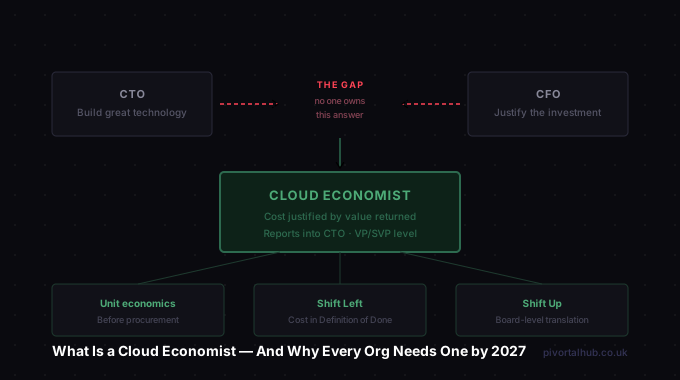
The room goes quiet in a specific way. Not because no one knows the answer. Because no one in the room owns the answer. The CTO knows the architecture. The FinOps analyst knows the bill. The Delivery Manager knows the roadmap. But the question being asked is none of those things. The question is whether the technology investment is generating proportionate value — and that question sits in the gap between all three roles.
That gap has a name. It is the Cloud Economist. And most organisations do not have one.
A Cloud Economist is not a senior FinOps analyst
The FinOps Foundation's Framework 2026 update introduced the concept of the FinOps-Enabled Executive — a senior leader who translates cloud financial data into boardroom strategy. It is a significant step forward from the FinOps analyst role that most organisations have been hiring for. But I think the framing undersells what is actually needed.
A FinOps analyst optimises existing cloud spend. They identify waste, right-size resources, manage Reserved Instance coverage, and produce chargeback reports. They are essential. But their mandate is fundamentally backward-looking — they are accounting for decisions that have already been made.
A Cloud Economist operates upstream of those decisions. Their mandate is to ensure that the technology investment being proposed — the new data platform, the AI programme, the infrastructure migration — is financially justified before the first pound is committed. They work at the intersection of economics, technology strategy, and delivery governance. MSc Financial Economics meets AWS Solutions Architect meets programme director. That combination is rare. It is also, I would argue, the most valuable hire a technology organisation can make right now.
The role sits above the FinOps function and below the CTO
In the organisations where I am seeing this role emerge, it reports into the CTO or CIO — not into Finance. That is deliberate. The Cloud Economist needs proximity to technology decision-making, not distance from it. They need to be in the room when architecture decisions are made, not reviewing the bill three weeks later.
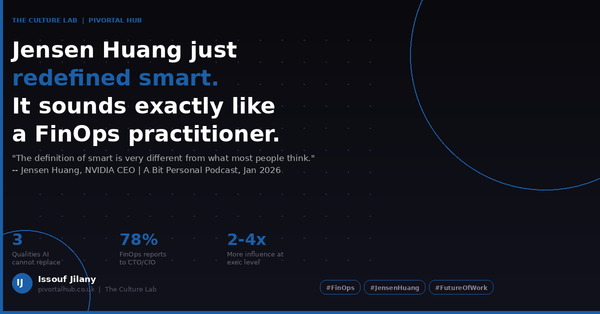
The FinOps Foundation's State of FinOps 2026 found that 78% of FinOps functions now report into the CTO or CIO rather than the CFO. That shift reflects a recognition that cloud cost is not a finance problem — it is an engineering governance problem. The Cloud Economist is the logical evolution of that shift. They are, in effect, the COO for the CTO — the person whose job is to make sure the technology organisation's resource decisions are as rigorous as its technical decisions.
Think of it in terms of Shift Up — one of the three pillars I apply in every engagement. Shift Up is about translating technical FinOps metrics into C-suite-ready strategy. The Cloud Economist is the permanent institutional owner of that translation. Not a consultant brought in quarterly to produce a report, but a senior practitioner embedded in the organisation who ensures that the financial logic of every significant technology decision is tested before it is approved.
Three things a Cloud Economist does that nobody else in the organisation does
The role is easier to understand through what it actually does. Three examples from current engagements.
Unit economics modelling before procurement. A CTO wants to run a GPU cluster for a new LLM fine-tuning programme. The Cloud Economist builds the unit economics before the purchase order is raised — cost per training run, projected inference volume, break-even at different adoption scenarios, comparison between on-demand, Reserved, and on-premises options. The CTO gets a decision brief, not a bill.
On-premises versus cloud trade-off analysis. When organisations hit a certain cloud spend threshold — typically around £3–5 million annually — the on-premises versus cloud question resurfaces. The Cloud Economist is the person who can run that analysis with credibility on both sides: understanding the TCO of on-premises infrastructure (capital cost, depreciation, operational overhead, staffing) while also understanding cloud pricing constructs (Savings Plans, Reserved Instances, Spot, egress costs). Without this role, the analysis is usually done by whoever is most motivated to reach a particular conclusion.
Embedding cost into the Definition of Done. This is Shift Left in practice. The Cloud Economist ensures that cost is a non-functional requirement — that no infrastructure change is marked complete without a cost owner, a resource tag, and a decommission date. They do not do this by auditing after the fact. They do it by being present in sprint planning and programme increment ceremonies, making cost governance a live engineering discipline rather than a monthly finance exercise.
Why 2027 is the deadline
Gartner predicts that 40% of enterprise applications will embed AI agents by end of 2026. Every one of those agents consumes compute. Every inference call, every retrieval, every autonomous action spins up resources and generates a token cost. Unlike traditional cloud workloads, agentic AI spend does not follow a predictable pattern — it scales with usage in ways that are genuinely difficult to forecast, and it is triggered by external events rather than scheduled jobs.
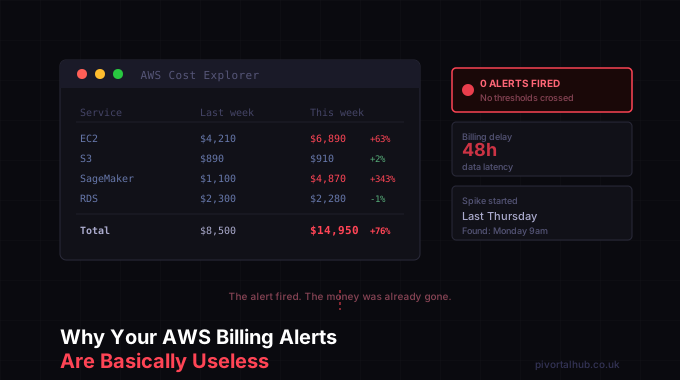
The organisations that are already deploying AI agents — and I am working inside programmes where this is live, not theoretical — are discovering that their existing FinOps tooling was not designed for this. Reserved Instance coverage does not apply to LLM inference costs. Cost Anomaly Detection has a 24–48 hour lag that is meaningless when an agentic workflow can burn through a monthly budget in an afternoon. The unit of cost is no longer the EC2 instance — it is the token, the API call, the agent decision cycle.
The FinOps Foundation's updated mission — Technology Value Management rather than cloud financial management — is a direct response to this shift. The scope has expanded because the spend has expanded. And the role required to govern that expanded spend is not a FinOps analyst with a broader remit. It is a Cloud Economist with a different mandate entirely.
Who becomes a Cloud Economist
The role does not emerge from a single background. I have seen it develop from three starting points, each bringing a different strength.
FinOps practitioners who develop strong business case skills. They already understand the billing layer and the tooling. What they need is the ability to translate that into executive language — to produce a recommendation that a CFO will act on, not a cost report they will file.
Cloud architects who develop financial literacy. They understand the technical decisions that drive cost. What they need is the economic framework to model the consequences of those decisions before they are made — unit economics, NPV, break-even analysis, total cost of ownership.
Delivery leaders with both FinOps and financial economics grounding. This is the path I have taken — 20 years of delivery leadership, an MSc in Financial Economics, hands-on AWS and IBM Apptio Cloudability experience, and current engagement at CTO level inside live AI delivery programmes. The combination is not common. That is precisely why the role is underserved.
What I am doing right now
- Building unit economics models for AI programme investment decisions at CTO level — cost per inference, token consumption forecasts, break-even at different adoption scenarios
- Embedding cost as a non-functional requirement in sprint Definition of Done — no infrastructure change marked complete without a cost owner, tag, and decommission date
- Running on-premises versus cloud trade-off analysis for organisations approaching the £3–5M annual cloud spend threshold
- Using IBM Apptio Cloudability and AWS Cost Explorer to build chargeback models that tie spend to product lines, not just AWS service categories
- Translating FinOps metrics into board-level language — cost per user journey, cost per AI transaction, cloud spend as a percentage of revenue — rather than presenting raw billing data
The CTO cannot own this — and here is the honest reason why
One question comes up every time this conversation reaches a CTO. Why can't I just own this myself? The honest answer is not about capability — it is about conflict of interest.
A CTO's mandate is to build great technology. A Cloud Economist's mandate is to make sure the cost of that technology is justified by the value it returns. Those two mandates pull in different directions every single day. When a team needs a new environment to hit a delivery deadline, the CTO says yes — because delivery is their primary job. The Cloud Economist asks what it costs, who owns the budget line, and whether it gets decommissioned when the sprint ends. You cannot hold both conversations simultaneously without one always losing.
The role needs an independent owner precisely because the tension is real and permanent — not because the CTO is incapable of understanding it. Every organisation that is serious about AI investment will have someone doing this job by 2027. The question is whether they create the role deliberately or discover it accidentally — usually after a cloud bill that nobody predicted and nobody can explain.
Does your organisation have someone who can answer the CFO's question at the forty-minute mark — not with a cost report, but with a financial justification? If not, that is the gap. And it has a name now.
About the Author
Issouf Jilany is a FinOps & Cloud Cost Optimisation Consultant, AWS Solutions Architect, and IBM Apptio Cloudability practitioner with approximately 20 years of delivery leadership experience across financial services and the public sector — including Lehman Brothers, Reuters, Lloyd's of London, HMRC and OFGEM. He is the founder of PivortalHub — a thought leadership platform at the intersection of FinOps, AI delivery, and cloud economics. MSc Financial Economics · MBA · SAFe SPC · SAFe RTE · AWS Solutions Architect Associate · IBM Apptio Cloudability.
Published on pivortalhub.co.uk · The Culture Lab