The Infantry Has Advanced. The Supply Convoy Has Not. Why Your AI Rollout Is More Exposed Than You Think.
AI tooling is advancing faster than organisations can absorb it. The tools are ready. The people, the processes, and the organisational maturity are not. Here is the governance framework that closes the gap.
FinOps · AI Governance · The Culture Lab
AI tooling is moving fast. Your people, processes and organisational maturity are the supply convoy. If the convoy cannot keep pace, the advance becomes a liability.
Issouf Jilany · September 2026 · 9 min read
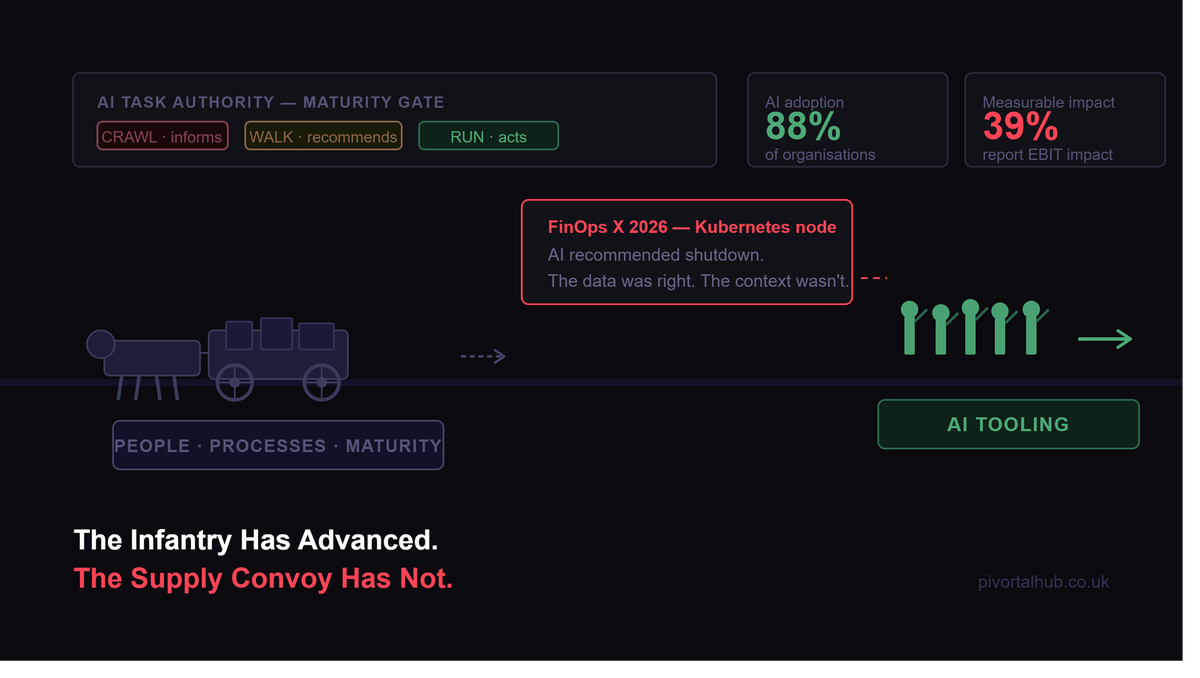
There is a principle every military commander understands that most CTOs have forgotten. The speed of an advance is not determined by how fast the infantry can move. It is determined by how fast the supply convoy can follow. Send the infantry forward without supply — without ammunition, fuel, food, medical — and the advance looks impressive on the map. On the ground it is a liability. Exposed, fragile, and one engagement away from collapse.
AI tooling is your infantry. It is moving fast. New models, new agents, new pricing constructs, new autonomous capabilities arriving faster than any organisation can absorb them. The question your board should be asking is not how far forward the tooling has gone. It is whether your people, your processes, and your organisational maturity are the supply convoy keeping pace — or the horse-drawn cart watching helicopters disappear over the horizon.
I am watching this play out inside live delivery programmes right now. The tooling is extraordinary. The organisational readiness underneath it is, in most cases, not keeping pace. And the gap between the two is where the expensive failures are waiting.
"The most dangerous place in enterprise AI is not where organisations are moving too slowly. It is where they are moving at the speed of the tool — without the people, processes and maturity to sustain the advance."
The tool always moves first. The organisation decides whether it follows.
At FinOps X in San Diego this June, Ishita Vyas, the FinOps Foundation's APAC Community Lead, gave an example that I have been using in CTO conversations ever since. An AI agent identified a virtual machine as idle and recommended shutting it down. The recommendation looked correct based on the available data. The cost was real. The idleness was measurable. The agent was doing exactly what it was configured to do. Then an architecture team stepped in and explained that the VM was a Kubernetes node — designed to remain idle until workload demand increased. Shutting it down would have broken the cluster.
The agent had the data. It did not have the context. And the context did not exist anywhere the agent could reach — because the organisation had not yet built the maturity to document architectural exceptions, inject them as governance rules, or maintain a team with the domain expertise to catch the gap before the recommendation landed.
Vyas called this the core risk of agentic FinOps: autonomy without context. I would put it more bluntly. The tool had moved to a capability level the organisation had not earned the right to use. The infantry advanced. The supply convoy was still at base camp.
This is not a FinOps problem. It is an enterprise AI governance problem that FinOps makes visible faster than any other function — because in FinOps, the cost of a wrong decision shows up on the next invoice.
Maturity is not a technology score. It is a people score.
McKinsey's 2026 AI research found that 88% of organisations now use AI in at least one business function. Only 39% report measurable business impact. Deloitte found that worker access to AI rose 50% in 2025 — but only 34% of organisations were genuinely redesigning how work gets done. The rest bolted AI onto existing processes, called it transformation, and measured success by licence counts rather than outcomes.
The gap between adoption and impact is not a tooling gap. It is a maturity gap. And maturity is not a property of your tools or your processes. It is a property of the people operating them.
A peer-reviewed paper published in Human Resource Development Review in July 2026 — Nolan Lovett's The Tragedy of the Cognitive Commons — makes the mechanism visible. AI adoption disrupts professional development through two simultaneous channels. It directly eliminates entry-level positions where junior staff historically built deep domain expertise. And even where those positions survive, junior workers with AI assistance hit productivity levels that used to take years to reach — without doing the cognitive work that actually builds judgment. The output looks the same. The understanding underneath it is not.
Lovett calls the downstream consequence the Validation Tether. The ability to oversee AI outputs effectively depends on exactly the kind of deep domain expertise that sustained AI use is eroding. The organisation loses the ability to catch the AI's mistakes at precisely the moment it becomes most dependent on AI outputs.
Jordan Wilson named the individual experience of this in Everyday AI episode 861: the Agent Bun Sandwich. Your domain expertise — the meat — is shrinking. You direct agents at the front end and check outputs at the back end. The middle, the craft, the judgment, the deep contextual knowledge — that is hollowing out. And as it hollows out, the maturity of the capability hollows out with it. The tool advances. The person operating it regresses. The gap between the two is where the Kubernetes nodes live.
Task authority must be gated by maturity — and maturity must be assessed per capability, not per team.
The governance framework that resolves this is not complex. But it requires a discipline that most AI rollout programmes are not applying. The tasks an AI system is permitted to perform autonomously must be determined by the organisation's demonstrated capability maturity in that domain — assessed independently, reviewed quarterly, and set by the lower of tooling maturity and people maturity, never the higher.
The FinOps Foundation's Crawl, Walk, Run maturity model maps directly onto AI task authority. But the critical nuance the Foundation is explicit about — and which most organisations miss — is that maturity is measured per capability, not per team. A FinOps team can be at Run for cost allocation and still at Crawl for commitment coverage. The governance question is never "what is our overall FinOps maturity?" It is "what is our maturity for this specific capability before we let AI act on it?"
Applied to AI task authority, the model works as follows. At Crawl, AI informs only — it surfaces data, identifies patterns, generates options. No autonomous action. Every output reviewed by a human with verified domain expertise before any decision is made. At Walk, AI recommends with structured friction — the human reviews using mandatory decision checkpoints, asks what the strongest counterargument is, names two failure modes, approves with documented rationale. At Run, AI acts within pre-approved guardrails — specific, documented, auditable boundaries set by an independent practitioner. Any action outside those boundaries requires human escalation.
The Kubernetes node failure was a Run-level autonomous action inside a Crawl-level capability. The gate was open because the tooling was sophisticated. It should have been closed because the people were not ready for what the tooling could do. Every significant tooling advancement — a new agentic platform, a new inference pricing model, a new autonomous capability — must trigger a maturity reassessment of the people operating it. Not the tool. The people. Because the tool just moved ahead of the expertise that was built against its predecessor.
Advancing maturity is the competitive strategy. Governing it is what makes the advance sustainable.
I want to be direct about the competitive dimension, because this framework can be misread as a case for caution. It is not. Analysis of 847 publicly traded companies found that organisations at advanced AI maturity stages now achieve operating margins 47% higher than those at early stages — a gap that was 21% eighteen months ago and is still widening. The organisations lagging are losing talent, losing margin, and losing ground on cost structures that compound every year. Not advancing maturity is not a safe position. It is an accelerating liability.
But here is what the same research shows: the organisations winning are not the ones who gave everyone AI access and moved fastest. They are the ones who invested deliberately in the human capability layer that allows them to operate AI at higher task authority levels, in more capabilities, more quickly, with fewer catastrophic governance failures. The fastest route to AI competitive advantage is not rolling out access. It is building the maturity that earns higher authority — faster, more deliberately, with measurable outcomes at each stage.
The army that advances fastest without supply does not win. It overextends and collapses. The army that advances at the pace its supply line can sustain wins — because it can hold the ground it takes. Strategic depth in AI is not tooling capability. It is the depth of human judgment that can sustain the advance when the tool is wrong, the context is missing, or the architecture has changed in ways the billing data cannot see.
Nuvepro's classification of 2.1 million tasks across 81 industries found a consistent pattern: roughly 30% of tasks can be fully automated, 40% should be augmented with human validation, and 30% are human-only. The competitive opportunity is in the 40% augmentation category — not in trying to push everything into full automation before the people and processes can sustain it. The organisations building durable AI advantage are investing in domain specificity and human judgment at the augmentation layer, not racing to eliminate human oversight in capabilities they have not yet earned the right to automate.
What I am doing right now
- Running capability-level maturity assessments before any AI tool is given decision authority in a FinOps function — tagging, anomaly detection, commitment coverage, and showback are assessed independently and gated separately
- Injecting architectural exceptions and business context into AI governance rules before agentic tools are permitted to generate rightsizing or decommission recommendations
- Running quarterly unassisted validation exercises — one real cost anomaly investigated manually by the FinOps team, output compared to AI output for the same period, divergence threshold reviewed
- Applying the 30/40/30 task classification to FinOps workflows: full automation only where tagging coverage exceeds 80% and exceptions are documented; augmentation with structured friction for anomaly detection and rightsizing; human-only for architectural decisions and commitment strategy
- Resetting maturity assessments every time a significant platform capability advances — because the tool moving forward does not mean the people have
The question is not whether your AI is ready. It is whether your organisation has earned the right to use it at the level it is operating.
The GoTo survey published in January 2026 found that 39% of all workers say their reliance on AI has weakened their skillsets. Among Generation Z — the cohort entering the workforce into AI-native environments — that figure rises to 46%. The people who have never built the domain expertise through doing the work manually are now operating AI tools at authority levels that require exactly the expertise they never developed. The supply convoy was never assembled. The infantry has been advancing on empty for months.
This is the Anchor Change challenge of our moment. Not changing the technology — that is happening with or without governance. Changing the organisational behaviour that treats tool access as maturity, that mistakes speed of deployment for depth of capability, that opens the gate because the tool is sophisticated rather than because the people are ready.
The remedy is not slowing down. It is advancing maturity deliberately and rapidly — per capability, assessed against people not tools, gated at the lower of tooling and human maturity, reset every time the tooling advances. Building the supply convoy with the same urgency and investment you are putting into the infantry. Because an advance without supply is not progress. It is exposure.
Your AI is operating at a level your organisation may not have earned. The Kubernetes node is the small version of that failure. What is the large version in your programme? And do you still have the people with the expertise to find it before it finds you?
About the Author
Issouf Jilany is a FinOps & Cloud Cost Optimisation Consultant, AWS Solutions Architect, and IBM Apptio Cloudability practitioner currently engaged at Lean Icon Technology. With approximately 20 years of delivery leadership across financial services and the public sector — including Lehman Brothers, Reuters, Lloyd's of London, HMRC and OFGEM — he is the founder of PivortalHub, a thought leadership platform at the intersection of FinOps, AI delivery, and cloud economics. MSc Financial Economics · MBA · SAFe SPC · SAFe RTE · AWS Solutions Architect Associate · IBM Apptio Cloudability.
Sources referenced in this article
Vyas, I. (2026). Agentic FinOps Maturity: Crawl, Walk, Run. FinOps X 2026 Day 2 Keynote, San Diego. FinOps Foundation. finops.org
Lovett, N. (2026). The Tragedy of the Cognitive Commons: How AI Could Disrupt the Regeneration of Professional Expertise. Human Resource Development Review, advance online publication, July 26 2026. NATO Special Operations University. journals.sagepub.com
Wilson, J. (2026). The 7 Silent Sins of Doing AI Right: How to Spot and Overcome the Invisible AI Work Traps. Everyday AI Podcast, Episode 861, Start Here Series Vol 20. youreverydayai.com
FinOps Foundation (2026). State of FinOps 2026. Sixth annual survey, 1,192 respondents, $83B+ annual cloud spend. data.finops.org
McKinsey & Company (2026). The State of AI: Global Survey. McKinsey Global Institute.
Deloitte (2026). Enterprise AI Report 2026. Deloitte Insights.
Nuvepro (2026). Task Intelligence: The Missing Layer Between AI Adoption and Enterprise ROI. Based on classification of 2.1 million tasks across 81 industries. nuvepro.com
GoTo (2026). AI Dependency in the Workplace Survey. Survey of knowledge workers on AI reliance and skill atrophy.
The Quantum Institute (2026). The Corporate Hacker's Guide 2026. Analysis of 847 publicly traded companies on AI maturity and operating margin. MarketResearch.com.
Published on pivortalhub.co.uk · The Culture Lab