Shift Up: FinOps Just Became a Boardroom Discipline. Here's What That Means for Delivery Managers.
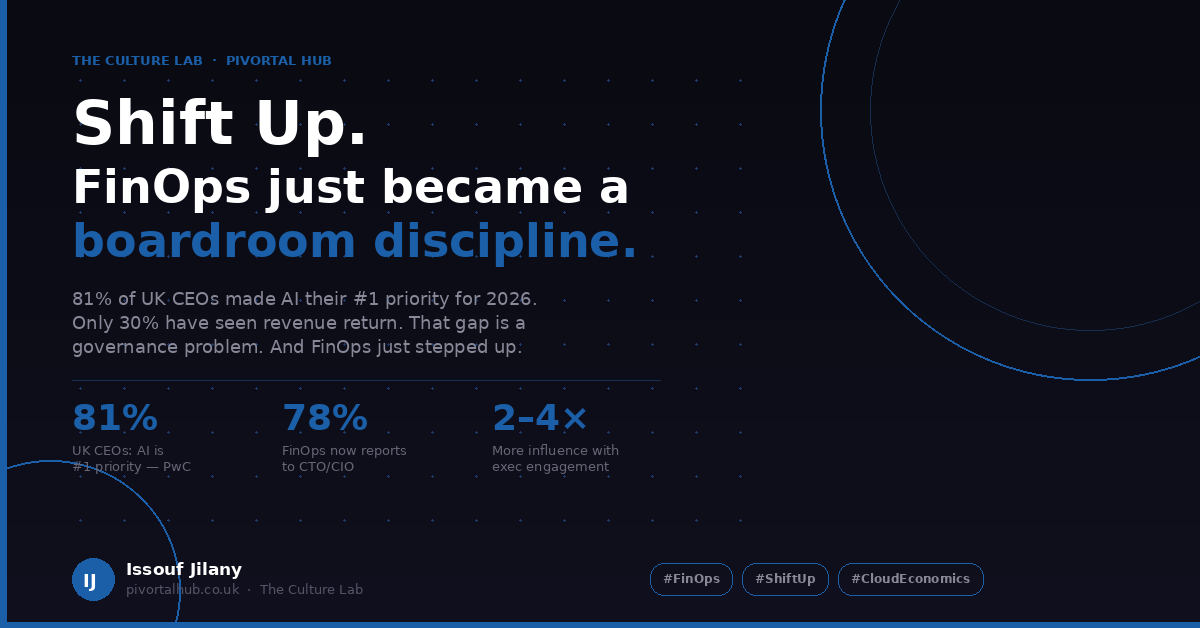
81% of UK CEOs made AI their number one priority for 2026. Only 30% have seen revenue return. That gap is not a technology problem — it's a governance problem. Here's what the FinOps Foundation just did about it.
This is the second article in The Culture Lab's series on the 2026 FinOps Framework. The first — on embedding cloud cost into your Definition of Done — is available here: pivortalhub.co.uk/embed-cloud-cost-definition-of-done
There is a quiet crisis happening inside UK organisations right now.
According to PwC's 2026 CEO survey of 4,454 executives across 95 countries, 81% of UK CEOs say technology, AI and data investment is their number one priority for 2026 — up from 60% just twelve months ago. Yet in the same survey, only 33% of UK CEOs believe their existing AI investment is sufficient to meet their goals. And only 30% have seen revenue actually increase from AI implementation.
Read those numbers together. Almost every UK CEO is prioritising AI investment. Almost none of them feel it is working.
That gap — between the urgency of investment and the absence of measurable return — is not a technology problem. It is a governance problem. And it is the reason that FinOps, which started as a way to manage cloud billing dashboards, has just been formally elevated to a boardroom discipline.
In February 2026, the FinOps Foundation updated its Framework and introduced a brand new capability: Executive Strategy Alignment. It formalises what the Foundation calls "Shift Up" — the evolution of FinOps from operational reporting to executive decision support.
The numbers that should be on every board agenda
Before we get to the FinOps Framework, it is worth grounding this in the business reality your leadership team is already navigating.
Info-Tech Research Group's Infrastructure & Operations Priorities 2026 report — focused specifically on UK IT leaders — found that 45% of organisations are prioritising cloud workload optimisation this year, while 52% identified reducing technical debt as a top infrastructure priority. Simultaneously, governance frameworks remain immature and foundational issues continue to slow AI progress.
The Logicalis 2026 CIO Report found that 94% of CIOs plan to lean on external partners over the next two to three years to help navigate AI governance, scaling and sustainability. That is not a vote of confidence in internal capability. It is an admission that most organisations do not yet have the governance structures to manage AI investment responsibly at scale.
"AI becomes the backbone of the digital economy, shifting from isolated proofs of concept to coherent, adaptive, and trusted value systems. This transformation demands not just technology, but governance and cultural readiness to embed AI into the very fabric of enterprise decision-making."
— Capgemini Research Institute, 2026Technology investment intent is at an all-time high. Governance readiness is not keeping pace. The financial consequences of that gap are landing on FinOps teams — and increasingly, on delivery managers.
What Shift Up actually means
The FinOps Foundation uses two complementary phrases to describe the 2026 direction of the discipline.
Shift Left — covered in my previous article — means embedding financial context earlier in the engineering lifecycle, before cost is committed.
Shift Up means something different. It means elevating FinOps from operational reporting to executive decision support — from explaining what was spent to shaping what will be invested.
The Framework's new Executive Strategy Alignment capability is built around three clusters:
Why 78% reporting to the CTO changes the power dynamic
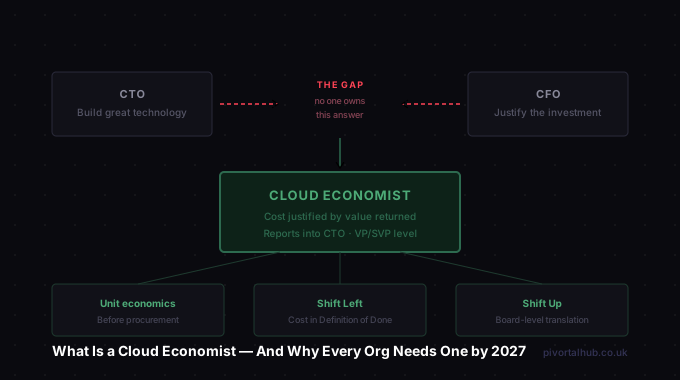
The State of FinOps 2026 report contains one structural data point that signals how much has changed. In 2023, roughly 60% of FinOps practices reported into the CTO or CIO organisation. In 2026, that figure is 78%. Teams reporting to the CFO have fallen to just 8%.
This is not a cosmetic change. It reflects a fundamental shift in what FinOps is being asked to do.
Financial control function. Retrospective reporting. Dashboards and anomaly alerts.
Technology value function. Proactive decision support. Shaping strategy before commitments are made.
Practitioners with VP or C-suite engagement are 2 to 4 times more likely to influence technology selection decisions than those operating only at Director level. Cloud service selection: 53% versus 12%. Cloud provider selection: 47% versus 8%.
Where FinOps sits in the organisation determines what it can influence. And influence at the strategic level is what Shift Up is about.
I have been doing this before it had a name
The FinOps Foundation did not invent Shift Up. It named something that mature practitioners have been building organically for years. I know this because I have been doing it — at HMRC and OFGEM — before there was a Framework term for it.
At HMRC, working with Accenture across the Alcohol Duty Reform and Pensions Administrator Reforms, I was producing financial trajectory reports for senior client management, engaging in technology procurement conversations on behalf of HMRC, and translating complex delivery performance into executive-ready investment decisions that shaped technology choices at programme level.
At OFGEM, as Senior Delivery Manager, I was connecting the cost of digital transformation to the regulatory and strategic priorities of the organisation at CTO level — establishing governance frameworks that made technology investment decisions accountable from the sprint board to the executive committee.
That is Executive Strategy Alignment. We just called it programme governance.
Now, as a FinOps and Cloud Cost Optimisation Consultant at Lean Icon Technology, I am building this capability explicitly for clients — developing cloud cost governance frameworks and spend visibility dashboards that connect technology cost to business value at executive level. Not reporting on spend after the fact. Informing investment decisions before they are made.
Five things Shift Up means for delivery managers right now
The question that matters
PwC's research found that exactly half of UK CEOs worry their organisation is not transforming fast enough to keep pace with AI and emerging technologies. That anxiety is real — and it is landing on technology leadership teams who are being asked to invest more, move faster and demonstrate more measurable return, simultaneously.
The organisations that navigate this successfully will not be the ones with the biggest AI budgets. They will be the ones with the governance infrastructure to make intelligent investment decisions — connecting spend to strategy, embedding accountability early, and translating complex technology cost data into executive-level clarity that drives confident decisions.
That is Shift Up. That is Executive Strategy Alignment. And that is the capability that delivery managers — who already live at the intersection of technology execution and business strategy — are uniquely positioned to build.
The FinOps Foundation has named it. The PwC data has quantified the stakes. The question is not whether your organisation needs this capability. The question is whether you will be the person who builds it.
Are you already practising Shift Up without calling it that? Drop your experience in the comments — the most interesting FinOps conversations right now are happening between practitioners who are doing the work before the Framework has named it.
Further reading: Executive Strategy Alignment — FinOps Framework 2026 · State of FinOps 2026 report · FinOps X 2026 — San Diego, June 8–11