The State of FinOps 2026 Just Redefined the Job. Here is What Delivery Managers Need to Know.

PivotalHub By Issouf Jilany | PivotalHub | The Culture Lab
Reading time: approximately 7 minutes
I read the entire State of FinOps 2026 report this week—all of it, cover to cover.
The FinOps Foundation publishes this survey annually. I have read every edition, but this one is different. This is not an update; it is a reclassification.
If you are a Delivery Manager, a Programme Director, a Scrum Master, or anyone responsible for shipping technology at scale—and you have not yet read this report—I want to save you time. Here are the five shifts that will redefine your role in the next twelve months.
The Headline That Changes Everything
The FinOps Foundation has updated its own mission. It no longer reads: "Advancing the people who manage the value of cloud." It now reads:
"Advancing the people who manage the value of technology."
One word swap. Enormous implications. FinOps has officially outgrown the "Cloud." The practice that started with AWS billing dashboards now covers AI spend, SaaS contracts, software licensing, and data centres. Notably, 28% of organisations are now including labour costs in their remit.
The era of "Cloud FinOps" is over. The era of Technology Value Management has begun.
1. Stop Thinking About Cost. Start Thinking About Value.
The report is unambiguous: while workload optimisation remains a priority, the collective focus on governance, organisational alignment, and forecasting now outweighs mere "waste reduction."
We have hit the "Optimisation Floor." One practitioner noted they reached 97% optimisation; the remaining 3% was a conscious business choice. The low-hanging fruit is gone.
What this means for you: The next wave of value isn't found in a dashboard; it’s found in how technology investments are planned and shaped before a single penny is spent. This is a delivery skill, not a technical one.
2. AI Cost Management: The Single Biggest Skill Gap
The numbers are staggering. In two years, AI spend governance went from a niche concern (31%) to a near-universal responsibility (98% of organisations).
Yet, the report identifies AI cost management as the #1 skillset teams need to add. The biggest hurdle? Determining AI value and ROI. As one practitioner noted: "Is your AI providing value? No one can answer that question yet."
What this means for you: This isn't a technology problem; it’s a governance and programme management problem. If you can apply Agile delivery discipline to AI spend, you are ahead of 98% of the market.
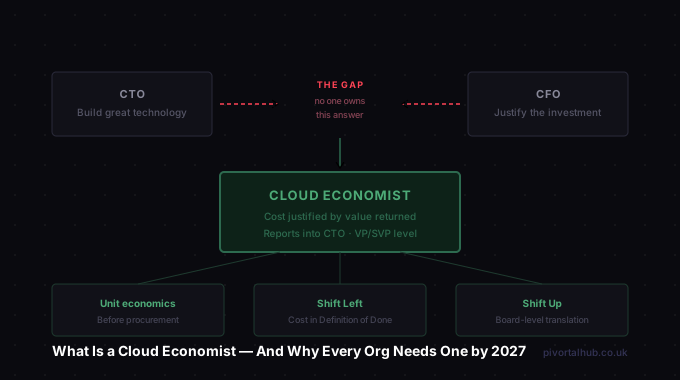
3. FinOps Has Moved to the CTO’s Office
In 2023, 60% of FinOps teams reported to the CTO/CIO. In 2026, that figure is 78%. Reporting to the CFO has plummeted to just 8%.
This shift changes the power dynamic. Practitioners with C-suite engagement are 2 to 4 times more likely to influence technology selection. FinOps is no longer a back-office reporting function; it is a strategic input into capital allocation.
What this means for you: Your "edge" isn't building better dashboards. It’s your ability to stand in front of a CTO and explain why an architectural decision made in a sprint has a £4M implication over three years.
4. The Scope Explosion
FinOps teams are no longer just "the cloud people." They are now managing:
- AI Spend: 98%
- SaaS: 90%
- Software Licensing: 64%
- Private Cloud & Data Centres: ~50%
The requirement today is to manage the full technology estate. The capability most needed? Proactive, real-time automation and planning. What this means for you: The "FinOps Generalist" who can govern value across multiple domains is the new most-valuable profile. This is no longer a specialist role; it is a strategic leadership capability.
5. The Federated Model: An Agile Problem
The report confirms that 81% of FinOps teams operate using a centralised enablement or "Hub-and-Spoke" model. Even massive organisations average only 8–10 central practitioners. They scale through federated champions embedded in teams.
This is precisely how a well-run Agile organisation operates. The most significant unsolved problem in the report is how to measure "Shift-Left" activities—giving engineers credit for preventing costs.
What this means for you: This isn't a tooling question; it’s a behaviour change question. It requires people who know how to build Communities of Practice and coach distributed teams toward new habits.
Closing Thoughts
The State of FinOps 2026 confirms the philosophy behind PivotalHub.
FinOps is not a cloud billing problem. It is a culture and behaviour problem dressed in cost-management clothing. The organisations that master technology value will be those who change how engineers think and how executives bet.
That is change management work. That is delivery work. It is the intersection of Agile discipline, financial rigour, and behavioural coaching—where I have spent my career.
The FinOps Foundation just updated its mission. It’s time we updated ours, too.
Read the full report at data.finops.org
What finding in the report changes how you think about your role? Drop your take in the comments.
Issouf Jilany is a Senior Delivery Leader and Cloud Economist with 20 years of experience across Lehman Brothers, Accenture, HMRC, and OFGEM. He specialises in Agile delivery, AI adoption, and Technology Value Management. SAFe SPC • SAFe RTE • AWS Solutions Architect